


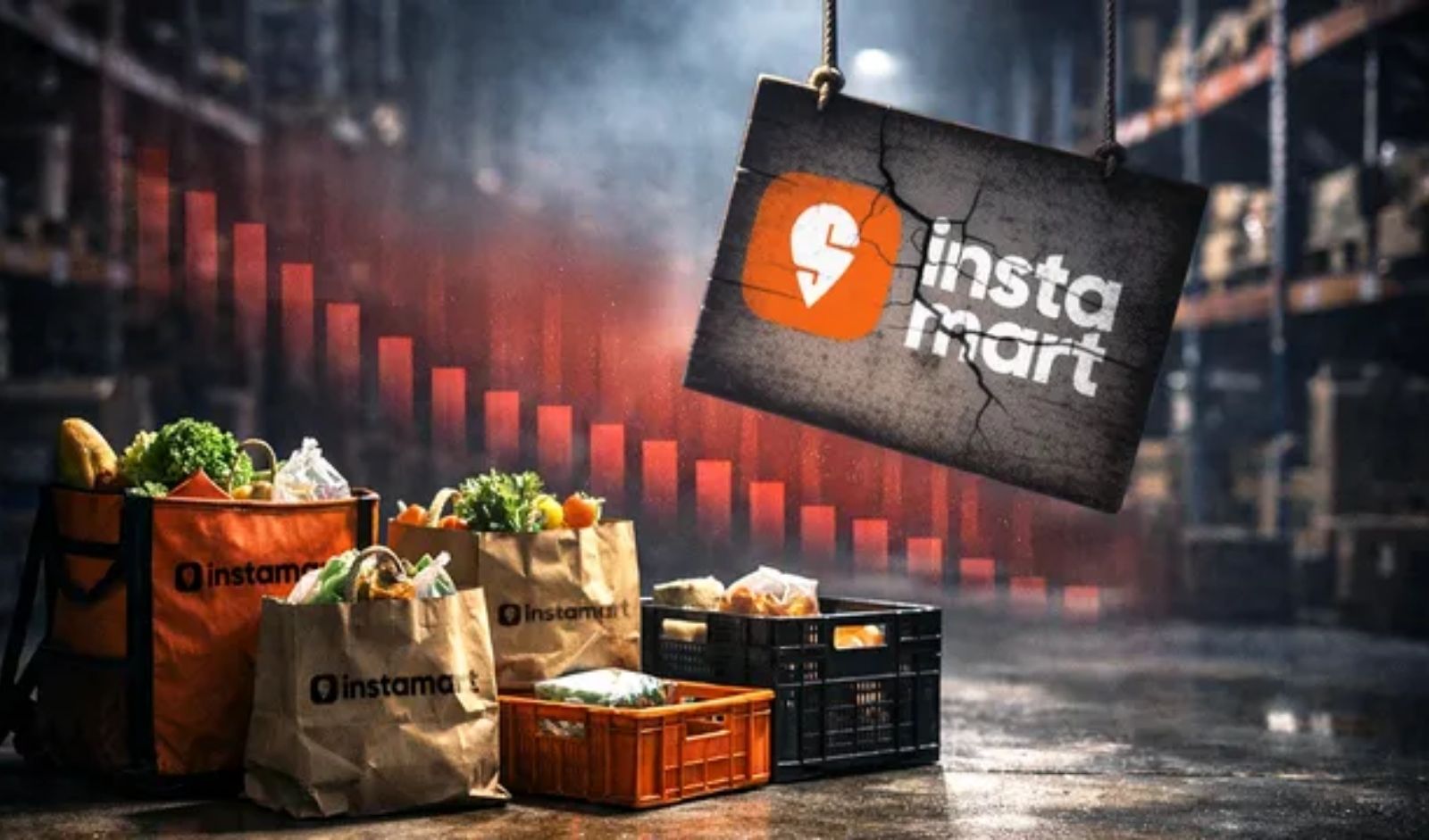
Swiggy is shifting its quick commerce strategy toward profitability and operational efficiency as competition in the sector intensifies with aggressive discounting and rapid expansion by rivals.
In its latest shareholder communication, the company said it rolled back its no-fee campaign in January 2026 to avoid what it described as “inducement-led volume gains” and instead focus on sustainable unit economics. Despite the move, Swiggy said Instamart recorded stronger sequential volume growth during the March quarter.
“We reiterate that a platform’s growth choices should be indexed on economics versus absolute volume increase,” said Sriharsha Majety. “One can grow significantly higher volumes in the short term in a large addressable market. However, the sustainability of that approach is questionable considering the high operating variable costs in the business as well as the expiry date attached to higher than sustainable consumer inducements.”
The company reported adjusted sequential volume growth of 8.2 percent in Q4FY26 compared with 5.5 percent in the previous quarter. Swiggy also stated that its contribution margin profile improved by 450 basis points over the past year as the platform continued balancing growth with profitability.
The strategy comes at a time when quick commerce operators are under pressure to maintain growth while managing rising operational costs and competitive pricing. Industry analysts believe Swiggy is gradually moving away from scale-focused expansion toward asset optimisation and profitability-led execution.
Karan Taurani said the company appears to be strategically pivoting “away from aggressive scale-led expansion toward asset utilisation, contribution margin break-even, and disciplined profitability”, even if that potentially leads to some near-term market share moderation for Instamart.
Swiggy maintained that the medium-term opportunity in quick commerce remains significant. Majety said the company expects Instamart to evolve into a net order value business of more than Rs 1 lakh crore with 4-5 percent EBITDA margins over the medium term.
The company also defended its store expansion strategy amid concerns that Instamart has expanded at a slower pace than competitors. According to Swiggy, the business has prioritised geographic coverage and network densification instead of focusing solely on headline store additions.
Over the last two years, Instamart’s dark store network increased 2.2 times from 523 stores to 1,143 stores, while total dark store area expanded 3.2 times from 1.5 million square feet to 4.8 million square feet. Swiggy said the investments were aimed at improving delivery efficiency and supporting a broader assortment strategy.
The company added that current network utilisation stands at around 40 percent and said it can “comfortably double” the business without major additional store expansion, except in areas where further densification is required.
“The time to operationalise a new store from the point of decision is less than 90 days and therefore we can remain agile to the market opportunity and growth curve without having to commit large store expansion numbers in the short term,” the shareholder letter noted.
Swiggy’s profitability-led approach signals a broader shift in quick commerce where operational sustainability, assortment quality, and customer retention are becoming more important than discount-driven acquisition.
Taurani also said the market currently values Swiggy’s food delivery business more heavily, while successful execution of its quick commerce profitability roadmap could create “meaningful optionality” and rerating potential over the medium term.
According to Taurani, Instamart’s gross order value grew 68.8 percent year-on-year in Q4FY26, although growth is expected to moderate as the company sharpens its focus on profitability and contribution margin break-even.
Swiggy also outlined a more defined positioning strategy for Instamart, stating that the quick commerce market is increasingly splitting between convenience-led and value-led retailers. The company said it plans to strengthen its presence in the convenience-focused segment.
“Our intention is to definitely play in the convenience segment, and cement our positioning on top,” Majety said.
Swiggy stated that reliable delivery, wider assortment, and live SKU availability remain central to Instamart’s offering, with the platform currently listing nearly 50,000 SKUs. The company added that it also sees long-term opportunity in premium and aspirational product discovery as consumer preferences evolve.
“We believe that there’s a huge opportunity in democratising the growing aspiration of the Indian consumer,” the company said, adding that its assortment strategy and convenience-led positioning are expected to support user growth and order frequency over time.
 ExpansionThe company said the partnership aligns with its broader strategy of introducing international gourmet brands to Indian consumers through a franchise…
 ExpansionThe launch comes at a time when hospitality brands are increasingly focusing on regional Indian cuisines and research-driven dining formats to…
 ExpansionThe launch reflects the continued expansion of international cuisine-led QSR concepts in Delhi, particularly in formats that combine customization,…
 LeadershipKhona’s earlier stint with the company gave him exposure to Starbucks’ global technology framework and its localization for the Indian market,…
Copyright © 2009 - 2026 Restaurant India.