





Swish reported operating revenue of Rs 47.6 crore in FY26, marking more than 10-fold growth over the previous year. However, the company's expansion and operating costs continued to weigh on its financial performance, with net losses rising nearly fourfold to Rs 91.1 crore.
Swish's total income, including other income, increased to Rs 53.8 crore from Rs 4.2 crore in FY25. Total expenses, meanwhile, climbed more than fivefold to Rs 144.8 crore, reflecting the cost of scaling its kitchen network, workforce and delivery infrastructure.
The comparison with FY25 comes with a caveat, as the company's previous financial statements covered July 8, 2024, to March 31, 2025, following its incorporation in July 2024. The year-on-year growth therefore compares a partial operating period with a full financial year.
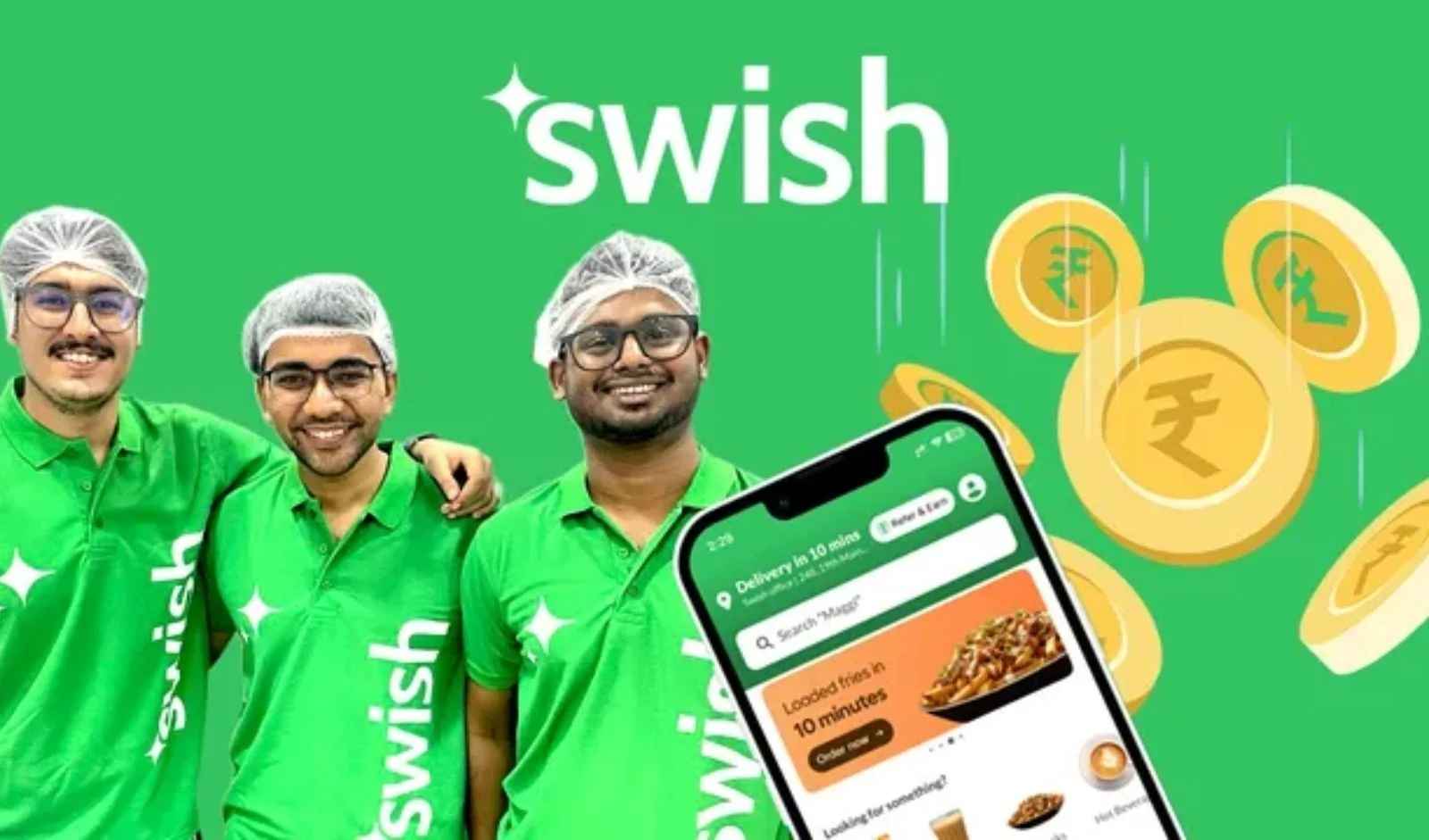
Founded in 2024 by Aniket Shah, Ujjwal Sukheja and Saran S, Swish operates a vertically integrated quick food delivery model through neighbourhood kitchens, in-house technology and last-mile delivery. Its kitchens generally cater to customers within a one-kilometre radius, with delivery timelines of 10 to 15 minutes. Unlike aggregator-led models, the company manages dedicated facilities for food preparation, cooking and order assembly.
The startup currently operates across Bengaluru, Gurugram, Noida, Delhi and Ghaziabad, covering nearly 50 pincodes. Its expansion strategy is centred on increasing kitchen density, entering new markets and strengthening its supply chain. Swish is targeting a network of more than 1,000 kitchens over the next five years.
In September 2026, Swish raised $24 million (approximately Rs 228 crore) in a funding round led by Bertelsmann India Investments, with participation from existing investors Accel, Bain Capital Ventures and Hara Global. The capital is expected to support kitchen expansion, new-city launches and supply chain development. The company had also raised $38 million in March 2026.
Swish has also started testing Swish Go, a third-party restaurant and cloud kitchen ordering service. Introduced in October 2026 across select Bengaluru pincodes, the service is positioned around affordable ordering, with the company removing packaging and platform fees from the proposition.
Employee benefit expenses emerged as the company's largest cost category, rising to Rs 55.71 crore from Rs 10.37 crore in FY25. Cost of goods sold increased 586 percent to Rs 39.48 crore, while other expenses grew 565 percent to Rs 44.39 crore, adding to the pressure on overall profitability.
The financial performance reflects the operating challenges associated with ultra-fast food delivery, where maintaining short delivery windows requires investment in kitchen locations, staffing, inventory and logistics. The model depends on order volumes and kitchen utilisation to absorb fixed costs, making profitability difficult as networks expand.
The segment has also seen companies reassess the economics of 10-minute food delivery. Swiggy discontinued its quick food delivery app SNACC amid profitability concerns, while Zing moved away from the model after weaker-than-expected demand and high operating costs, highlighting the difficulty of sustaining speed-led delivery propositions at scale.
-
GrowthThe capital is expected to support kitchen expansion, new-city launches and supply chain development. The company had also raised $38 million in…
 Growthhe launch also expands IHCL’s presence in North Bengaluru, where infrastructure development and commercial activity are driving demand for…
 ExpansionThe new outlets cater to different dining occasions and cuisines. Fireback serves Thai cuisine under chef David Thompson, known for his expertise in…
 GrowthThe company's event catering business also serves corporate clients, including Hardcastle Restaurants, the master franchisee operator of…