


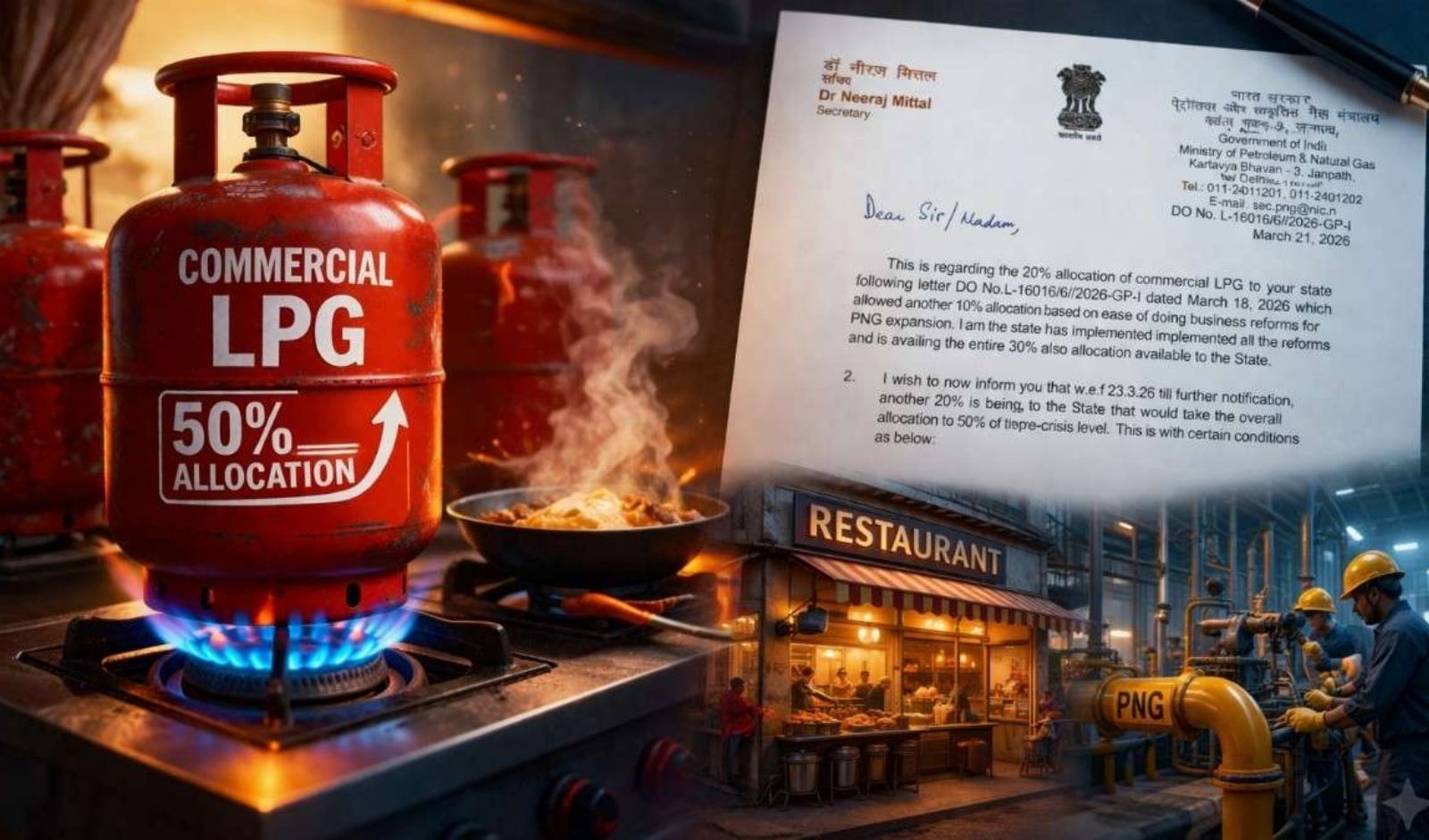
The Centre has approved an additional 20 percent allocation of commercial liquefied petroleum gas (LPG) to states and union territories, offering some relief to restaurants, hotels, and other foodservice operators impacted by supply cuts.
The revised allocation will cover key segments including restaurants, dhabas, hotels, industrial canteens, food processing units, dairy businesses, subsidised canteens run by state governments and local bodies, and community kitchens. The additional supply will also support refills of 5-kg cylinders used by migrant labourers.
With this increase, total commercial LPG allocation can now reach up to 50 percent of the estimated requirement. Earlier, the government had allowed 20 percent allocation, followed by an additional 10 percent subject to states taking steps to accelerate piped natural gas (PNG) infrastructure.
The move comes after a significant reduction in LPG supplies to commercial and industrial users, as the government prioritised household consumption. The disruption was triggered by the closure of the Strait of Hormuz amid the ongoing West Asia conflict, affecting a major portion of India’s LPG imports.
India relies on imports for about 60 percent of its LPG demand, with nearly 90 percent of those imports routed through West Asia via the Strait of Hormuz. The government also directed refiners to increase LPG production and divert inputs such as propane and butane from petrochemical manufacturing to LPG output.
These measures have increased domestic LPG production by around 40 percent compared to pre-war levels, contributing roughly 16 percent to the country’s overall demand. The rise in domestic output has enabled the government to enhance allocations to the commercial segment, although supply remains sensitive to global conditions.
To streamline distribution, the government has made it mandatory for commercial and industrial LPG users to register with public sector oil marketing companies such as Indian Oil Corporation, Bharat Petroleum Corporation, and Hindustan Petroleum Corporation. Additionally, businesses must apply for PNG connections to qualify for LPG allocations.
Neeraj Mittal, stated, “OMCs shall register such customers and keep a record of the sector they operate in the end-use of LPG and annual weight requirement of LPG of that customer in respective database(s)…All commercial/industrial LPG consumers shall have to apply for PNG with the City Gas Distribution (CGD) entity in their city as applicable and take all actions that will take them to a state of readiness for receiving PNG before they can be eligible to be allotted any commercial LPG from the overall 50% allocation,” Mittal wrote.
The government has been encouraging both commercial users and households to shift to PNG where feasible to reduce dependence on LPG supplies. Data shared indicates that over 1.25 lakh new gas connections, including domestic, commercial, industrial, and compressed natural gas (CNG), have been issued in recent weeks, while more than 5,600 LPG consumers have transitioned to PNG.
Regulators such as the Petroleum and Natural Gas Regulatory Board have also advised city gas distribution companies to accelerate network expansion and customer onboarding. Incentives including waived connection charges and limited free gas volumes are being offered to encourage adoption.
Despite disruptions to natural gas imports as well, the impact remains relatively lower compared to LPG. India imports roughly half of its natural gas requirements, with 55–60 percent coming through the Strait of Hormuz.
The government said LPG cylinder deliveries are currently being maintained at pre-conflict levels, with no reported shortages across approximately 2,500 distributorships. It also noted that panic buying among households has eased. The additional allocation provides short-term relief, but the transition toward PNG infrastructure is expected to become a key requirement for ensuring stable fuel supply going forward.
 LeadershipThe appointment reflects ongoing focus within the hospitality sector on strengthening marketing leadership to drive brand differentiation, customer…
 Restaurants chainHe will lead the group’s restaurant business, which includes global brands like PizzaExpress, Chili’s, P.F. Chang’s, and Olive Garden.
-
RestaurantThe government said LPG cylinder deliveries are currently being maintained at pre-conflict levels, with no reported shortages across approximately 2,…
 Food businessThe latest move is expected to stabilise operations across the hospitality sector in Maharashtra, where access to consistent fuel supply remains…
Copyright © 2009 - 2026 Restaurant India.